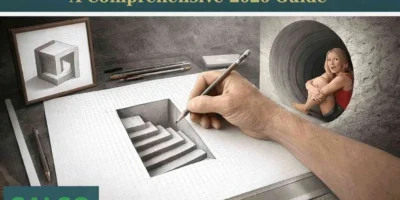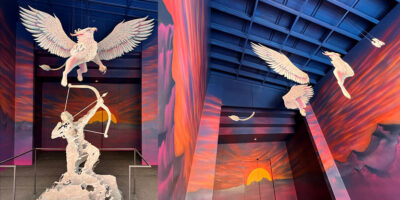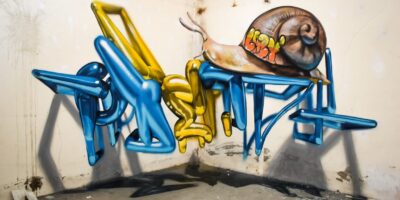

Optical illusion mirror artworks have the immense power to transform ordinary spaces into captivating experiences where perception and reality no longer align. From vibrant patterns to mind-bending visuals, these 3D mirror illusions manipulate our perception of size, distance, and proportion.
Understanding how these illusions work reveals the science behind them and opens up new possibilities for creative expression in both artistic and functional settings. In this blog, we will cover:
- What are mirror optical illusions
- How to make an optical illusion using mirrors
- Creative optical illusion mirror artworks
- How the brain processes a mirror illusion
If you’re looking to bring a new, magical vibe to your museum, park, or cafe, make sure to explore our 3D art studio services and find out how our team can bring your ideas to life.
Now, let’s dive in!
What Are Mirror Optical Illusions & How They Work
An optical illusion mirror is a reflective surface designed to manipulate perception by changing how light, angles, and space are interpreted by the viewer. Instead of reflecting reality accurately, it creates distorted, duplicated, or seemingly three-dimensional visuals depending on the viewing angle.
But how does the optical illusion work? These mirrors work by carefully controlling reflection angles and spatial arrangement. When a viewer looks into the mirror from a specific point, the reflected image aligns to produce the intended illusion. However, from other angles, the illusion breaks, revealing the underlying distortion.
Optical illusion mirror artworks often include distinctive visual elements to enhance the effect:
- Geometric patterns such as circles, grids, and intersecting lines that guide the viewer’s perception
- Repetition and symmetry to create infinite or looping reflections
- High contrast and color variation to emphasize depth and separation
- Layered reflections that make spaces appear larger, duplicated, or distorted
- Immersive compositions commonly used in environments like mirror mazes and illusion rooms

How to Make an Optical Illusion Using Mirrors
One of the most interesting and creative forms of art is the mirror optical illusion. Much like the process of drawing an optical illusion, the mirror optical illusion explanation lies in the fact that these works use carefully designed techniques to create images that appear impossible or seem to defy normal perception.
But how to make an optical illusion using mirrors? Let’s follow the steps below:
- First, you need to create a basic image. This image can be anything from a simple figure to a complex scene.
- Then, you need to add elements that appear impossible or confusing. You can do this by using special techniques that manipulate light and images.
Some of the most famous optical illusion mirrors are those that create bizarre and incredible images. These optical illusion mirrors mostly challenge our understanding of reality and how we see things. They rank among the most imaginative and captivating art forms.
5 Creative Optical Illusion Mirror Artworks
Let’s see 5 stunning optical illusions with mirrors that will captivate your senses and leave you wondering how the artists brought them to life:
1. Infinite Mirrors
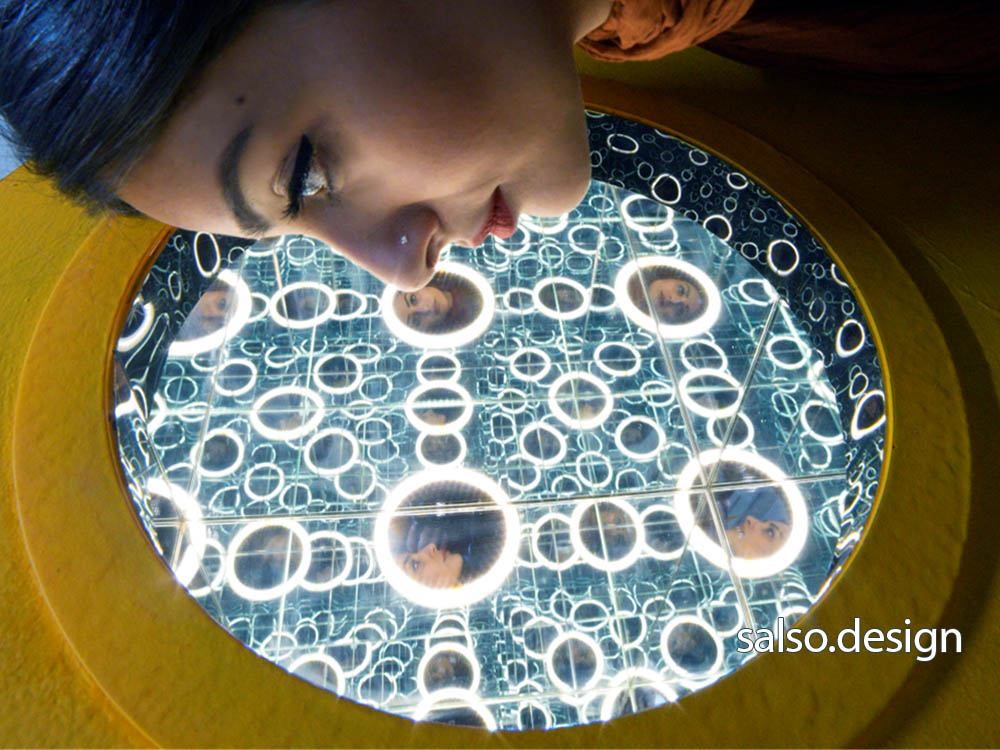
In this mirror optical illusion, mirrors combined with LED lights or reflective surfaces create the illusion of endless depth. They make a mesmerizing, almost hypnotic visual effect that seems to extend forever.
If you’re wondering how this effect is created, explore how we made an infinity mirror hall for one of our striking projects.
2. Ames Room Mirrors
In the Ames room illusions, mirrors or mirror arrangements distort perspective. So, people appear smaller, taller, or warped. These mirrors are often featured in optical illusion exhibitions or art installations.
3. Kaleidoscope Mirrors
In this type, mirrors are arranged in geometric patterns that multiply and reflect objects to create kaleidoscopic effects. This optical illusion with mirrors adds vibrant, symmetrical, and ever-changing visual patterns.
4. Anamorphic Mirror Arts
The mirrors are shaped or positioned so that an image appears distorted until viewed from a specific angle. As in many 3D anamorphic art examples, this mirror-illusion art also combines art, math, and perspective for a magical effect.
5. Patterned Illusion Mirrors
In mirror maze optical illusions, mirrors are etched with shapes, symbols, or layered patterns that distort or multiply reflections. These create unique, interactive artworks where viewers become part of the illusion.
How the Brain Processes an Optical Illusion
An optical illusion occurs when the brain interprets visual information in a way that differs from physical reality. Instead of passively recording what the eyes see, the brain actively analyzes patterns, depth cues, and prior experience to construct meaning, which sometimes leads to misinterpretation.
To better understand this process, consider how the brain responds to different types of illusions:
1. The Effect of the Mirror Optical Illusion
In mirror-based illusions, the brain relies on spatial cues and reflection patterns to interpret depth and orientation. When mirrors alter or repeat visual information, the brain attempts to organize these reflections into a coherent space. This can result in distorted perceptions of size, distance, or direction, especially when the viewing angle is controlled.
2. Inversion Effect
The inversion effect occurs when an image is flipped upside down, disrupting the brain’s ability to recognize familiar patterns. Since the brain is optimized to process upright images, inversion can make objects appear unusual or harder to interpret.
3. Pareidolia
Pareidolia is a phenomenon in which the brain perceives familiar shapes, such as faces, in random places like clouds or textures. This happens because the brain is wired to detect meaningful patterns, even when none intentionally exist.
4. Frisbee Illusion
Some illusions occur when objects are arranged in ways that conflict with expected spatial relationships. The brain uses visual cues such as alignment, angle, and proximity to interpret these scenes, which can lead to the perception that objects are shifted, stretched, or disconnected.
Overall, optical illusions work by exploiting how the brain processes visual information, highlighting the gap between what we see and what actually exists.
Conclusion
Optical illusion mirror artwork reveals just how easily our perception of reality can be shaped by design. By combining reflection, perspective, and spatial arrangement, these illusions transform ordinary surfaces into immersive visual experiences that challenge how we interpret size, depth, and space. From iconic examples like the Ames Room to modern mirror installations, the underlying principle remains the same: what we see is not always what truly exists.
If you’re looking to bring a magical element into your theme park, museum, marketing campaign, or even your house, make sure to contact us. Our team of illusion artists at SALSO Design Studio is available to breathe life into your most abstract ideas.
FAQs on Optical Illusion Mirror
Now, let’s delve into the most commonly asked questions about optical illusion mirrors.
1. What Are the Mirror Illusions Called?
Mirror illusions are commonly known as anamorphic illusions when they rely on specific viewing angles, and mirror-based optical illusions when they use reflection to distort or duplicate images. In many cases, they are also referred to as optical illusion mirror artwork in design and artistic contexts.
2. What Is the Rarest Type of Optical Illusion?
There isn’t a single “rarest” optical illusion, but some of the least common are complex spatial illusions that require precise design and viewing conditions, such as the Ames Room or advanced mirror-based installations.
These illusions are rare because they depend on carefully controlled angles, perspective, and environment to work correctly. In addition, the appearance of three suns in the sky over China is called sun dogs, a rare optical illusion caused by sunlight bending through ice crystals in the atmosphere.