
If you’ve ever stopped dead on the street to stare at a painting on the ground that seemed to pop out or break the pavement in two, you already know the answer to “what is 3D anamorphic art?” In short, it’s the discreet use of shading, shapes, colors, and perspective that tricks the eye into perceiving depth and dimension, creating mind-bending, immersive experiences.
3D anamorphic art is a visually appealing art form used in public spaces, on social media, and increasingly in brand and experiential design to create an engaging experience. Skilled artists draw on perspective and optical illusions to make flat, two-dimensional surfaces appear three-dimensional when viewed from a specific angle.
From painted sidewalks that seem to open into bottomless chasms to large-scale digital displays that stop people in their tracks, 3D anamorphic art challenges how humans perceive the world around them. In this guide, we cover:
- What is 3D anamorphic art, and how does the illusion work?
- What are the different types and real-world applications of 3D anamorphic art?
- Who are the notable artists, and how do they create 3D anamorphic art?
If you’d rather skip ahead and get started with your next 3D anamorphic art project, our team of skilled illusion artists is ready to help you bring your 3D project to life.
The Illusion of 3D Anamorphic Art
3D anamorphic art is a striking form of visual art that uses precise techniques to create the illusion of three-dimensional objects or scenes on a two-dimensional surface. Artists meticulously calculate angles, proportions, and perspective to make the artwork appear realistic and immersive, but only when viewed from a specific vantage point.
The optical trickery involved in 3D anamorphic art allows for mind-bending effects, such as:
- Objects seemingly floating in mid-air
- People walking on walls
- Chasms opening up beneath the viewer’s feet in 3D street paintings
- Structures appearing to extend far beyond the surface they’re painted on
The use of shading, shadows, and intricate detailing further enhances the illusion of depth, making the art come alive from the correct viewing position.
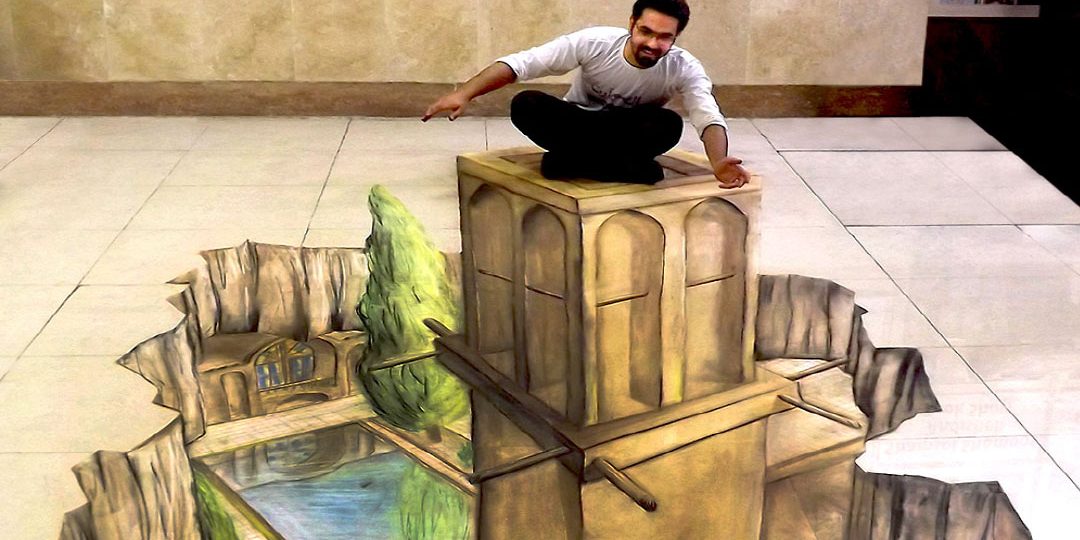
How Anamorphic Perspective Works
If you’re silently wondering, “What is 3D anamorphic art?” the answer comes down to how it works! The optical trickery involved in 3D anamorphic art works by manipulating human visual perception through the masterful use of angles and proportions. By applying the principles of perspective deliberately, artists force the viewer’s eye and brain to interpret a 2D surface as 3D.
The technique distorts reality and plays with depth cues, such as linear perspective, relative size, shading, and occlusion, to create dramatic illusions that engage and surprise. An anamorphic drawing is intentionally stretched and skewed on the surface. From most angles, it looks distorted and unreadable. But from one specific viewpoint, it snaps into a convincing 3D image.
The illusion of depth and the viewer’s active participation in the artwork truly distinguish anamorphic perspective art from a regular painting or mural! The immersive nature of this experience is the reason why many designers and marketing executives transform floors and walls with anamorphic illusions at their events.

What is 3D Anamorphic Art vs. Trompe l’Oeil
These two terms are often used interchangeably, but they refer to entirely different concepts.
What is Trompe l’oeil? This term is French for “deceives the eye” and refers to a broader technique where artists paint with such realism that the viewer is tricked into thinking depicted objects are physically real, regardless of viewing angle.
What is 3D Anamorphic art? By contrast, it is a more constrained form of visual illusion that requires the viewer to find a specific vantage point, or use an optical device, such as a curved mirror, for the image to resolve correctly. Anamorphosis is effectively a specialized tool within the broader tradition of illusionism, adding the dimension of position to the illusion.
In practice, many 3D anamorphic artworks combine both approaches: they use trompe l’oeil realism within an anamorphic structure to maximize the visual impact. However, this doesn’t mean that the two terms could be used interchangeably to refer to the same technique.
The Importance of 3D Anamorphic Art
Now that we have defined “What is 3D anamorphic art?” it’s time to dive deeper into why it’s trending. One of the primary reasons why 3D anamorphic art draws more attention day-by-day is the ability to engage and captivate viewers in a way that traditional art forms simply cannot. It breaks the boundaries of conventional art and offers a unique, interactive experience.

3D Anamorphic Art Captivating Viewers
What is 3D anamorphic art’s attraction, and why is it a trending technique today?! People are drawn to the sense of wonder and surprise that comes with witnessing an artwork transform before their eyes. But it doesn’t end here!
The 3D anamorphic art doesn’t just spark surprise and wonder but also encourages viewers to become part of the artwork as they seek out the optimal viewing angle to fully appreciate the illusion. Unlike a painting hung on a gallery wall, an anamorphic work requires participation. The viewer must move, position themselves, and look, and in that moment, the illusion rewards them.
This form of art transports individuals into a different reality, stimulating their imagination and challenging their perception of space and dimension. The interactive nature of the experience is central to its power.
3D Anamorphic Art in Public Spaces
3D anamorphic art brings art to life in public spaces, transforming ordinary sidewalks, streets, and walls into extraordinary installations. The element of immersion and interactivity invites participation, as people pose and photograph themselves as part of the illusion.
This engages communities, draws crowds, and re-imagines the possibilities of art and public spaces. Anamorphic 3D art has the powerful ability to stop people in their tracks and capture their imagination. That’s why it’s become a valuable tool, and not just for art galleries, but for urban plans, museums, theme parks, and even guerrilla marketing campaigns to create memorable experiences.
To understand the core principle of “what is 3D anamorphic art”, we should consider real-life examples of the artwork in action.
Real-World Applications of 3D Anamorphic Art
The same geometric principle of designing for a constrained viewpoint could be applied across a wide range of surfaces and formats. If you’re wondering what is 3D anamorphic art use case and application, let’s get started.
Street and Pavement Art
Street and pavement works are the most recognizable format of 3D anamorphic art. Artists paint on sidewalks, plazas, and floors, or use 3D anamorphic stickers with images that appear flat or distorted from most angles but reveal a stunning 3D illusion from a single, specific viewpoint.
The viewer typically steps into the scene to take a photograph, becoming part of the illusion. This is what makes 3D sidewalk art one of the most shareable forms of public art; the experience is personal, interactive, and highly visual. Sidewalk illusions and anamorphic floor decals have become popular attractions at festivals, brand activations, shopping centres, and public squares worldwide.
Murals, Walls, and Architectural Installations
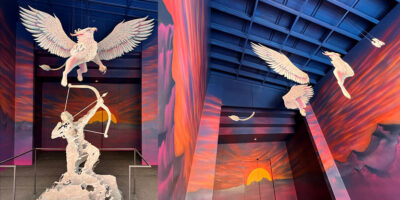
Anamorphic techniques extend naturally to vertical surfaces, such as walls, building façades, stairs, and multi-surface architectural environments. A 3D anamorphic mural can make a flat wall appear to open up, reveal a hidden space, or display objects that seem to physically protrude from the surface.
On a larger scale, anamorphic art installations can span entire buildings or city blocks, with painted fragments distributed across multiple surfaces that cohere into a single image from a single precise vantage point. These large-scale works are used in museums, theme parks, retail environments, and public art commissions, creating destinations that people travel specifically to experience.
Digital Displays and Anamorphic Design
One of the fastest-growing applications of anamorphic principles is in digital out-of-home (DOOH) advertising and large-format LED displays. By designing content for a specific viewing direction and exploiting the curved or angled geometry of modern screen installations, studios can create 3D anamorphic illusions at architectural scale, without any paint or chalk.
A well-known example is the “WAVE” installation by design studio d’strict at COEX K-POP Square in Seoul. A massive curved LED screen displays a wave that appears to be crashing against the inside of a glass box. This kind of anamorphic display has become a benchmark for what’s possible when digital content meets spatial perspective design.
Anamorphic design is increasingly used in brand campaigns, retail environments, and experiential marketing, where the goal is to create a moment so visually striking that audiences stop, photograph, and share it.
The Appeal of 3D Anamorphic Art
3D anamorphic art appeals to a wide range of individuals, and that cross-demographic reach is a big part of what makes it such a powerful medium.
- Art enthusiasts appreciate the technical skill and precision required to create these illusions. The mastery of anamorphic perspective represents a high level of artistic and geometric expertise.
- The general public, including tourists and passersby, is fascinated by the unexpected and eye-catching nature of these artworks. There’s an element of discovery involved, as facing a 3D anamorphic illusion in a public space is a genuine surprise.
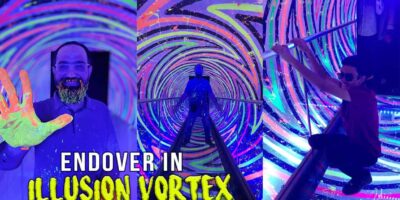
- Children, though they don’t know what is 3D anamorphic art, enjoy the playful, imaginative quality of the artwork. When exploring artistic displays in illusion museums, children interact with the artwork with a sense of curiosity and excitement.
- Social media audiences are among the most enthusiastic consumers of anamorphic art. 3D anamorphic art has gained growing popularity on social media, such as Instagram and TikTok, where people love sharing photos and videos of themselves interacting with the illusions. The combination of surprise, technical mastery, and shareability makes anamorphic 3D creations widely engaging across demographics.
Regardless of the context, the 3D anamorphic perspective has become an attraction, drawing in crowds and providing unique, immersive experiences for visitors.
Notable 3D Anamorphic Artists
Many famous 3D artists have gained their international renown for their skill in 3D anamorphic art. These are some of the most recognized names in the field:
- Kurt Wenner: Often called the “father of 3D pavement art,” Wenner is credited with developing the special geometry required for large-scale sidewalk illusions. His work appears globally and sets the technical and artistic standard for the genre.
- Julian Beever: A master of chalk 3D pavement art, Beever is known for crafting the illusion of depths and protrusions on flat pavements. His work popularized the format internationally and demonstrated the viral power of anamorphic street art long before social media existed.
- Manfred Stader: He specializes in hyper-realistic anamorphic paintings that appear three-dimensional, often working on large urban surfaces with a strong emphasis on photorealistic detail.
- Leon Keer: Leon paints elaborate murals with anamorphic effects, working with shifting perspectives and optical illusions to create layered visual experiences in public spaces.
- Edgar Mueller: He is known for creating street paintings that play with 3D effects and the illusion of movement and time, and producing large-scale works that transform entire public squares.
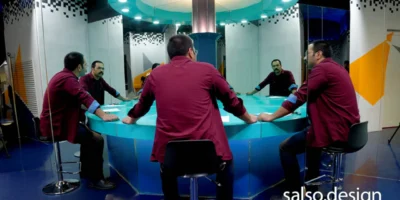
- Saleh Sokhandan: Saleh is known for anamorphic works that are visually spectacular and technically precise, with a strong international following. He leads a team of expert designers at SALSO Design studio, where 3D anamorphic techniques are implemented in theme park projects, illusion museums, and printable 3D floor and wall stickers.
- John Pugh: Using anamorphic techniques on architectural murals, he makes walls appear to bulge, bend, or open up when viewed from specific angles. His work often integrates seamlessly with real architectural features to enhance the illusion.

How to Create 3D Anamorphic Art
Aside from what is 3D anamorphic art, many ask if they can create an artwork on their own. It is abundantly clear that creating a convincing 3D anamorphic artwork is impossible without a strong understanding of perspective, careful planning, and methodical execution.
Here’s a step-by-step overview of the process:
- Study perspective drawing techniques to understand how to convey depth on a 2D surface. Mastering principles like foreshortening and vanishing points is key to the end result.
- Use gridding to map out your anamorphic design and ensure proper proportions from the intended viewing angle. Draw grids on the surface and your reference image.
- Outline the major elements of your design first before adding details. Accurate initial proportion and perspective are critical.
- Add shading, shadows, and highlights to create the illusion of form, depth, and lighting. Darker shades recede; lighter tones come forward.
- Use line weight variation in your drawing to further suggest depth and dimension. Thicker lines appear closer to the viewer.
- Incorporate realistic surface textures that tie into your 3D illusion. Textures that recede into the distance should appear less focused.
- Limit your color palette so the illusion is not broken. Avoid complex patterns and color variations that could disrupt the depth cues.
- Pick a well-suited subject; architectures or objects with strong perspective lines work best. Avoid elements that may contradict or flatten the depth.
- Consider extending your art beyond the canvas with real 3D objects to further deepen the illusion.
- Choose a suitable surface, such as pavements, walls, or canvases, that you can view from optimal angles.
- Take photographs from the intended viewing spot regularly as you work to check accuracy and adjust proportions.

The same principles and processes apply to making 3D stickers for floors or walls! With practice and a solid understanding of anamorphic perspective techniques, you can learn to create stunning 3D anamorphic artworks on almost any surface.
Bring 3D Anamorphic Art to Your Space
3D anamorphic art transforms spaces and shapes the experiences people have within them. Whether you’re designing an immersive installation for a theme park, creating a signature mural for a retail environment, or developing anamorphic content for a large-scale digital display, the impact is immediate and lasting.
At SALSO Design, we specialize in 3D optical illusion projects, ranging from custom 3D stickers and murals to full-scale illusion museum and theme park installations. If you’re ready to create an experience that genuinely wows visitors, explore our portfolio and get in touch with our team.
Last Words on What is 3D Anamorphic Art
As a visually stunning and captivating form of artistic expression, 3D anamorphic art pushes the boundaries of perception, bringing flat surfaces to life and inviting viewers to engage. The creative use of proportion, angle, and perspective forces the mind to interpret flat paintings as 3D worlds.
The immersive nature of Anamorphic art 3D techniques and the immense power it has over our minds, have made this art form very popular. Nowadays, you may face them in the streets, art galleries, theme parks, and museums, or even your favorite cafe!
In this blog, we’ve covered the definition and use cases for 3D anamorphic art, why it’s important, and how you can create one on your own!
Frequently Asked Questions on What is 3D Anamorphic Art
The anamorphic 3D effect is an optical illusion created by distorting a 2D image so that it appears three-dimensional when viewed from a specific angle. The artwork looks stretched from most angles, but turns into a convincing 3D image from the intended viewing spot.
Anamorphic art refers to artwork that uses the technique of anamorphosis, a perspective method in which an image is deliberately distorted and can only be seen correctly from a particular viewpoint or with the aid of an optical device, such as a curved mirror. The term “anamorphosis” comes from the Greek word for “transform.”
3D art includes a wide range of forms: anamorphic street and pavement art, large-scale wall murals and architectural installations, trompe l’oeil painting, stereoscopic art (which uses two slightly different images to create depth for each eye), sculptural 3D work, and digital 3D anamorphic displays on LED screens. Anamorphic art is distinct in that it relies on a single specific viewpoint, rather than binocular vision or physical depth, to create its effect.
Brands, retailers, and experiential agencies use 3D anamorphic art to create high-impact moments in physical spaces. Common applications include branded anamorphic murals at product launches or pop-up events, 3D illusion installations in retail stores and shopping centres, anamorphic content on large-format digital displays, and custom illusion experiences in theme parks and museums.
The shareable nature of anamorphic art makes it particularly effective for campaigns that aim to generate organic social media reach.