
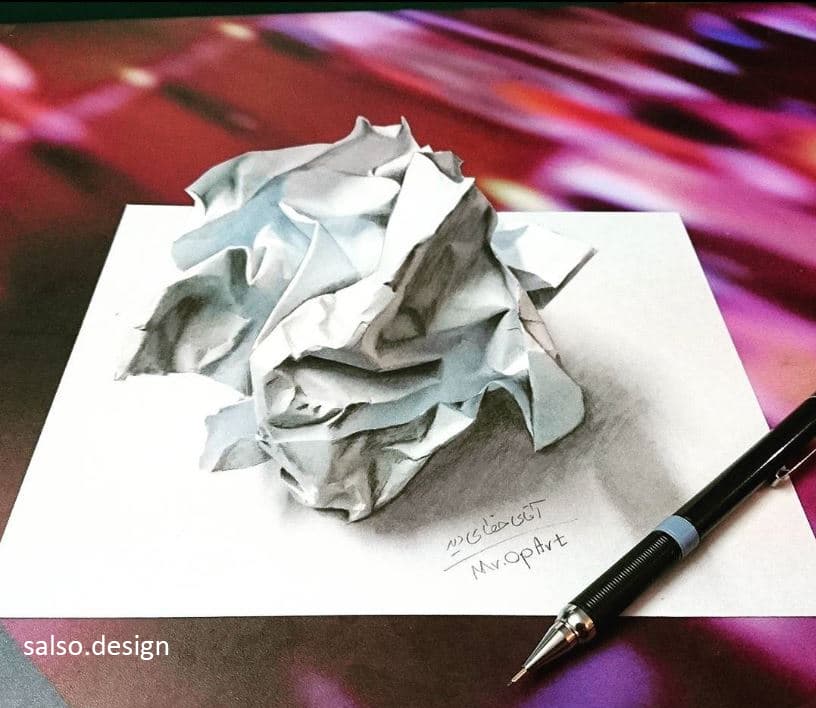
Behind every 3D painting technique, and at the very core of how to draw a 3D painting, lies the concept of quasi-three-dimensional transformation. The magic lies in the fact that these works are not truly three-dimensional; instead, they create the illusion of depth through precise design.
The 3D painting techniques applied ensure that the three-dimensional effect is fully visible only from a specific viewing angle. When captured from that exact perspective, typically using a mobile or standard camera, the best 3D output image appears exactly as the artist intended.
In this blog, we’ll cover the following important topics:
- How to draw a 3D painting
- 3D painting techniques and methods
- The distinguishing factor between a 3D digital painting and a hand-painted work
Before we get started, you can also explore examples of customizable 3D artworks for different purposes to gain a better initial understanding. Now, let’s dive in!
What Is 3D Painting
The art of 3D painting is a collection of different abilities. In recent years, it has evolved beyond traditional chalk and wall media with artists now integrating augmented reality (AR) apps, mixed-media installations, and interactive projection mapping to enhance viewer immersion.
These capabilities are at the service of:
- Implementing the desired idea,
- Designing the perspective space,
- Or more simply, implementing the 3D anamorphic illusions on different levels.

Principles of 3D Paintings
From the first sketch to the final result, the principles of 3D painting make it possible to apply anamorphic designs to different surfaces. Using 3D anamorphic art perspectives, designs can be created on surfaces in a way that produces the illusion of depth and dimension.
The ability to paint and draw in perspective helps create a more realistic result. However, this should not discourage those who want to enter the field, as using the 3D painting techniques outlined below even allows beginners to bring their ideas to life.
What Are 3D Anamorphic Painting Implementation Techniques
There are different techniques for performing 3D painting. Depending on their experience in painting, each artist uses their own methods to create a 3D painting.
Many modern artists often complement traditional techniques with digital tools such as Photoshop, Blender, or specialized anamorphic design software. Meanwhile, AI-powered design tools now suggest optimal distortions and angles for the viewer’s perspective, reducing trial and error and accelerating workflow.
Most artists use the eye and stencil method. Using the camera aperture, they constantly check that they have followed the original design, or they use a template. That is the first design of the project in a modified form on a small scale, and then execute it on the ground. The surface they work on is smooth in 90% of cases, either on the wall or the floor. Very few artists can perform 3D painting on multiple surfaces.
All 3D painting techniques eventually turn into a metamorphic image that follows geometric rules. As a result, the output of all techniques is the same. What makes the work stand out is the artist’s idea of the performance, the artistic style, and the precise execution of the transformational design technique on the surface.
In this section, we’re delving into the methods that produce a three-dimensional painting.
1. Eye Method
The history of 3D painting reflects that the eye method is one of the most popular techniques. In the ocular method of 3D art techniques, the artist constantly observes the painting from the intended viewpoint. If the necessary tools are not available, the artist can physically move to the correct viewing angle to check the work. To do this, the artist must repeatedly move between the viewing position and the painting.
Using a camera and monitor makes this process much simpler. With their help, the artist can view the work from the correct perspective without constantly changing position. This allows the artist to achieve the desired three-dimensional effect more accurately. This method is especially simple and convenient for smaller drawings, such as 3D paintings on canvas or paper.
2. The Method of Shading Objects or Radiation
In this technique, the artist first creates the design in its final form of how it’s intended to be seen. The design is then mapped onto the desired surface and prepared for execution.
The artist then transfers the design onto the surface, often using 3D projection mapping or reference guidance. Modern tools, such as video projectors, make it easier to project the image onto the surface accurately. It should also be noted that 3D painting involves a range of different ideas and execution techniques.
3. Geometric Method
The geometric method is relatively accurate. This method was first introduced in 2014 by Saleh Sokhandan. Using this approach, the artist can start the design without a template or project image. However, he must constantly check the result to ensure accuracy. In the geometric method, the main shapes, lines, and angles can be implemented more accurately.
Artists use this technique in the early stages of their work, as they implement the main lines and basic shapes on the surface. Then, they design the details using the eye method and learned experience.
The geometric technique, however, has strict rules. But most artists in this field learn this 3D painting technique through experience. After trial and error with the eye or stencil method, they find out what the lines’ convergence in the painting looks like.
4. Patterning Method or Template
The patterning method uses small photographs, such as portrait paintings. In this method, the artist first takes a photo of the desired surface from the intended angle. Then he starts painting the design from the same perspective, and using the obtained patterns on the checkerboard. Also, if the desired surface is the ground, he squares it to 1 meter and then transfers the design to it.
For example, the artist is painting a part of a bear’s face. He sees that the bear’s eye is horizontal in the third square and vertical in the fourth and notes which part of the square it occupies. Using this method, the design can be transferred to the checkered surface. This can be done even without graphic software. Of course, graphic software that can draw or zoom in helps make these steps easier.
5. Algorithmic Method
The most famous 3D artists apply this 3D art technique to achieve the desired dimensions with the highest accuracy across a variety of surfaces. This is the most accurate way you can apply the metamorphic design technique to a quasi-3D space, from drawing simple volumes such as cubes and cylinders to complex volumes.
In this method, each space point is converted to a point on a two-dimensional plane. The algorithmic method was first introduced in 2014 by Saleh Sokhandan. This technique is a set of mathematical formulas that depend on the point of view and the location of the drawing pages.
In these 3-dimensional painting techniques, any point in 3-dimensional space becomes a coordinate on a 2-dimensional plane. For example, designs can be easily implemented to the desired exact dimensions. In addition, you can draw exactly one cubic meter, so that if we put a box one meter in the same place, there will be no difference from the viewer’s point of view.
How to Make 3D Paintings
The illusion created by these artistic techniques does not appear correctly from every angle. Instead, the image is designed for a specific viewpoint, from which it appears as a realistic three-dimensional form. To achieve this effect, the design must be drawn so that it is seen correctly from that particular angle. The more unusual the angle or point of view, the more interesting the painting looks.
Not everything from this particular angle of view and design techniques has changed. Actually, a 3D painting is a combination of two important points:
- First, draw a picture that can be seen correctly from a certain angle. It means accurately implementing transformational design techniques on the surface.
- Second, note that the painting has a three-dimensional relationship with the environment and the page on which it is painted. That is, if we are painting on a canvas, our design and painting must be three-dimensionally related to the space of the canvas.
For instance, consider that you want to paint a wooden box. The first point is to determine the viewing angle before anything else. Then, you need to design the box in the right position, meaning the angle and perspective should reflect how the box would appear if it were actually present. If this plan is executed using transformational techniques, it will produce a convincing result: A wooden box that fits the ground and is believable.
How to Learn 3D Drawings
The method and technique of 3D painting can be useful for everyone, from a product designer to a teacher, or anyone who wants to present their ideas in a more attractive way. In order to be able to draw a good 3D painting, you must first strengthen your design skills through:
- Mastering the basics of drawing and painting,
- Putting what you have in mind on paper and drawing.
Both of these items should be addressed from figure design to facade and perspective design, which helps you draw better.
Ultimately, you need to practice visualization to start learning 3D painting. This means developing the ability to imagine any object you see around you. You should be able to mentally visualize it from different angles and rotate it in your mind. You also need to train your perception by observing how objects behave in real space.
For example, consider how a vase sits on a table and how its appearance changes when viewed from different angles. And what makes it natural? With consistent practice, 3D art techniques become tools for translating your ideas into visual form. In other words, you learn execution methods that allow you to bring your mental designs onto the visual surface. It means learning the execution techniques that we explained in the previous section.

What Is 3D Digital Painting
3D digital drawings are usually printed on durable labels and pasted in place. These paintings have greater quality and durability than hand-painted works. In addition, it is possible to correct the mistakes as opposed to hand-painting.
The quasi-three-dimensional metamorphic painting is performed in two methods:
1- Manual Method
This method is famous and common. The artist performs the whole 3D painting using chalk pastels or paints on the desired surface.
2- The Digital Method
In the digital method, the artist paints and prints the painting digitally. Then it sticks to a specific surface in the desired location.

3D Digital Painting vs 3D Hand Painting
3D digital drawings are created using computer-based tools. This is the main difference between digital and manual 3D painting techniques. However, hand-drawn 3D works on physical surfaces may also be designed digitally beforehand. In both painting processes, the design is often first created digitally, allowing the final result to be reviewed and adjusted in advance. But the important difference between the two techniques is in how they are used.
Digital 3D painting can be printed and installed quickly, making it more practical for large-scale production and lower cost. They allow for high levels of detail and consistency, which is why 3D stickers are widely used in product marketing and advertising. Also, more quality and detail can be added to it; this customization means 3D stickers are more popular in product and publicity ads.
In contrast, manual 3D painting requires significant time and is created directly on-site. One of the interesting features of a 3D painting is that the painter can communicate with the audience while painting, and the viewers can:
- Observe the work as it develops,
- Ask questions,
- Communicate with the artist.
It is therefore suitable for festivals, promotional, and cultural events. To get more information, just contact us.
Conclusion on 3D Painting Techniques
The simplest way to create 3D art is the eye-based technique, making it an excellent starting point for beginners. This method is easy to learn and efficient in practice. A free video course for this technique is available on Mr. Khataei Did’s website. You will quickly become familiar with the generalities of this technique, and you can even start drawing 3D paintings as you’re learning.
FAQs about How to Draw 3D Arts
If you still have some questions about 3D drawing and painting, keep reading:
1. What Are the Applied Skills in 3D Painting?
As mentioned earlier, not everything depends on technique alone. You have to:
- Understand the concept of 3D art
- And develop the necessary skills.
These skills include drawing in perspective space, shading, painting, and so on.
To build these abilities, it is recommended to study under experienced instructors or attend relevant art courses. The key to creating a transformational (anamorphic) design lies in working within perspective and three-dimensional space. This means being able to represent three-dimensional forms and volumes on a two-dimensional surface. After these steps, you can achieve a remarkable, extraordinary effect.
2. Which One: 3D Poster, 3D Sticker, or Digital Painting?
These terms are not interchangeable. 3D painting refers to the actual artistic technique (anamorphic illusion art). In contrast, 3D posters and 3D stickers describe the format or material the design is printed on. For accuracy, the correct term for the art itself is 3D painting.
3. What Is the Ability to Duplicate or Reprint the 3D Painting?
This allows the effect to be reproduced multiple times. But hand-painting requires the artist to recreate the work each time, leading to higher costs. In contrast, digital 3D painting allows for easy reprinting because the original file is preserved.
Another advantage of digital files is the ability to print on a variety of materials. As printing technology continues to advance, it offers new possibilities, including printing or displaying images on different surfaces. That is, instead of printing it, display it on the desired surface. This capability forms the basis of projection mapping techniques.
4. Is a 3D Digital Painting Economic?
In hand-painting, the artist must spend a lot of time creating the design in the desired location. This results in higher costs due to the time required and the need for the artist’s physical presence at the location. In contrast, in the digital approach, time spent on-site is replaced by the installation of printed materials such as posters or stickers. So, the designer spends his time in his office designing the digital effect. Additionally, reprinting the work is relatively inexpensive compared to recreating a hand-painted version.
Another advantage is the ability to send a print or files and produce the artwork in different locations. This feature allows you to use the 3D effect in the most remote countries and regions. The artist does the design in his office and sends the print file to your location.
5. Who Are 3D Digital Painting Artists?
Most 3D artists began as two-dimensional painters before entering this field. Their artistic ideas and styles are clearly reflected in their works, which have led to the creation of many unique and visually striking pieces. You can follow the artists in this field in the section introducing 3D painters.
As mentioned earlier, these artists worked in the field of two-dimensional painting. For this reason, relatively few of them work with digital techniques. Some may feel that digital methods lack the same artistic value, and therefore choose not to pursue them.
However, some artists in this field collaborate with a colleague or design studio, like Tracy Lee Stum, who has designed some of his work digitally. On the other hand, many digital designers have shown less interest in digital design. It is rare for digital designers to enter the digital art design space.
6. What Is the Advantage of a 3D Sticker or Poster Compared to Hand Painting?
3D digital drawing on a computer is designed digitally. This is the main difference between digital and manual 3D painting techniques. However, hand-drawn 3D drawings on different surfaces may also be digitally designed. In both painting processes, the design is often created digitally first, allowing the final result to be reviewed in advance. But the important difference between the two techniques is in how they are used, as explained in the previous section.
These differences do not mean that one method is superior to the other. In short, using 3D painting is a more commercial and economical method than painting.