The Ames Room illusion is an amazing enigma that has captured the fascination of scientists, psychologists, and enthusiasts alike. Named after its creator, American ophthalmologist Adelbert Ames Jr., the Ames Room continues to baffle and amaze us with its ability to deceive our senses.
The Ames Room illusion is a captivating example of an optical illusion that challenges our perception of size and shape. Actually, it challenges our visual perception, distorting our understanding of depth and size.
Constructed using clever architectural techniques that manipulate perspective and depth cues, the Ames Room illusion tricks our brains into perceiving an optical illusion. In an illusion museum, the Ames Room serves as a mesmerizing exhibit where visitors can experience the power of visual deception firsthand.
In this blog, we’ll cover the definition of the Ames Room illusion, how it works as an optical illusion service, and how you can use it for your next design project.

What Is the Ames Room Illusion?
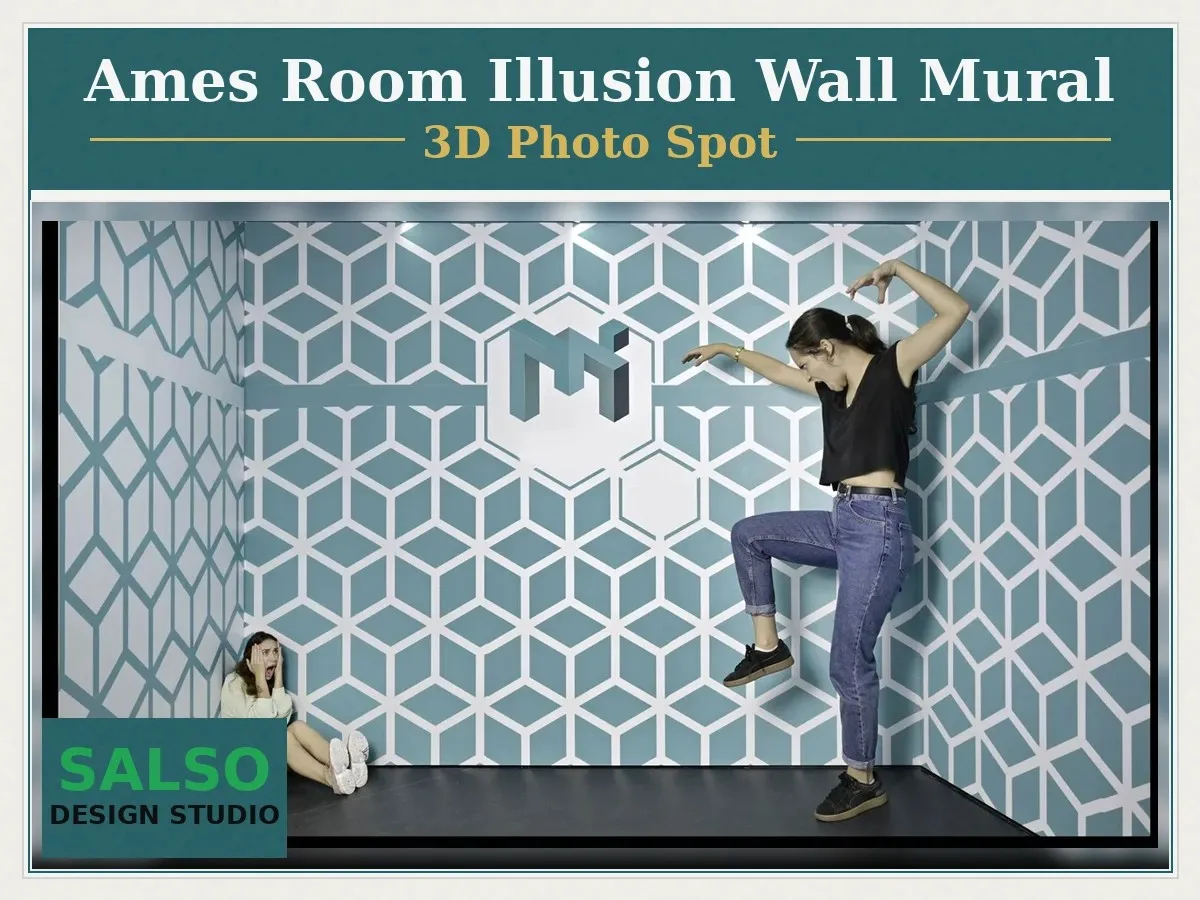
The Ames Room illusion explanation is not as complicated as it may look! The room is a perceptual phenomenon that defies our expectations of how objects should appear in relation to one another. From a specific vantage point, the room appears perfectly rectangular, with one corner seeming much closer than the others.
In the context of the Ames Room, a visual trick occurs when the room is deliberately constructed to distort perspective, making people and objects appear different in size and shape.
So, when individuals enter the Ames illusion room and observe each other from the designated viewing point, an extraordinary transformation occurs. One person appears significantly taller or shorter than the other, despite their actual heights being identical. This mind-boggling illusion challenges our understanding of visual perception and leaves us questioning the reliability of our own senses.
The Ames Room illusion is often applicable for creative theme park design ideas and illusion museums.
How Does an Ames Room Work?
To comprehend the Ames Room Illusion, it is crucial to understand its construction. The room is designed in a trapezoidal shape, with one corner closer to the observer than the other. The walls, floor, and ceiling are all meticulously crafted to create an illusion of perfect rectangularity. By manipulating the angles and dimensions of the room, the illusionist is able to trick the viewer’s perception of depth and size.
The key to the Ames Room illusion is the positioning of the people within the room. The person closer to the viewer is placed in the larger section of the trapezoidal room, while the person farther away is positioned in the smaller section.
This clever arrangement, combined with the carefully calculated angles, creates an illusion of normal proportions when viewed from the designated vantage point. As a result, the brain is fooled into perceiving a regular, rectangular room, even though it is far from it.
Similar to the Ames Room illusion, the mirrors’ optical illusion artwork is another fascinating example of optical illusions that can:
- deceive our perception,
- and create the illusion of depth.
The Evolution of the Ames Room in the Study of Visual Illusions
The Ames Room Illusion has a rich history that spans over a century. Its inception can be traced back to the early 20th century when Adelbert Ames Jr. first introduced the concept to the scientific community.
Ames, who was fascinated by visual perception, constructed the room as a means to study depth perception and the role of size constancy. His groundbreaking experiment paved the way for further research into visual illusions and contributed to our understanding of how our brain processes visual information.
Over the years, the Ames Room Illusion has served as a catalyst for advancements in the field of psychology. Researchers have used this illusion to investigate various aspects of visual perception, such as
- depth cues,
- size constancy,
- and the role of context in shaping our perception.
The Ames Room continues to be a valuable tool in the study of visual illusions, providing valuable insights into the complexities of human perception and cognition.
Fascinating Experiments and Demonstrations of the Ames Room Illusion
The Ames Room illusion has been the subject of numerous experiments and demonstrations, each shedding light on the intricacies of visual perception. Here, we mention two interesting trials related to the Ames Room optical illusion:
1. Psychological Examination for Ames Room
One notable Ames Room illusion image experiment was conducted by Richard Gregory, a prominent British psychologist, and included a window. By adjusting the window size and lighting conditions, Gregory discovered that these factors significantly influenced the viewer’s perception of the room’s shape and dimensions. This experiment highlighted the role of contextual cues in shaping our visual perception.
2. Illusionists’ Test for the Ames Room
Another captivating demonstration of the Ames Room Illusion can be found in the realm of magic and performance arts. Magicians and illusionists have utilized the principles of the Ames Room to create mind-bending tricks and illusions. By manipulating the angles and dimensions of the room, they are able to make objects or people appear to shrink or grow in size. This application of the Ames Room in the world of entertainment showcases its versatility and the enduring fascination it holds for both performers and audiences.
Ames Room Illusion in Psychology & the Film Industry
Except for all their applications, Ames Rooms are really practical in two popular fields:
1. Ames Room Illusion in Psychology
The Ames room illusion in psychology has been used to explore the limitations and biases of human perception. By studying how individuals perceive the Ames Room, researchers gain insights into the mechanisms underlying visual perception, which can be applied to various areas such as advertising, product design, and user experience.
2. Film Industry in the Ames Room
Indeed, the film industry has embraced the Ames Room Illusion to create visually stunning and mind-bending cinematic experiences. Filmmakers have employed similar techniques to those used in the construction of the Ames Room to deceive the audience and transport them into imaginary worlds. By manipulating perspective and dimensions, filmmakers can create surreal and otherworldly scenes that captivate viewers and challenge their understanding of reality.

Famous Case Studies for the Ames Room Illusion
Ames Room has garnered widespread recognition and has been featured in various contexts. Let’s discuss two examples this way:
1. Ames Room Optical Illusion in The Lord of the Rings
One memorable example is the iconic movie “The Lord of the Rings: The Fellowship of the Ring,” where the character Gandalf appears significantly taller than the hobbits Frodo and Sam. This effect was achieved using an Ames Room, showcasing the illusion’s versatility in the realm of visual storytelling.
2. Ames Room in Advertisements
Another famous example of the Ames Room illusion can be found in the world of advertising. Companies have employed the illusion to create attention-grabbing advertisements that play with the viewer’s perception. By utilizing the deceptive nature of the Ames Room, advertisers can create memorable and impactful campaigns that leave a lasting impression on the audience.
Aside from the advertisements, you will also find the Ames Room illusion in theme park design and optical illusion museums.
The Last Word on the Ames Room
The Ames Room Illusion continues to captivate and intrigue us, challenging our understanding of visual perception and the reliability of our senses. Its construction and manipulation of perspective deceive our brains, leaving us in awe of the complexities of human perception.
From its historical significance to its real-world applications, the Ames Room Illusion has made a lasting impact across fields such as psychology and the film industry. As we delve further into the mysteries of visual perception, the Ames Room remains a fascinating enigma that reminds us of the intricacies of our own perception. To learn more about how you can implement it for the best outcome, just contact us.
FAQs on Ames Room
Let’s discuss some of the most common questions about the Ames Room.
1. How Does the Ames Room Picture Demonstrate Context Effect?
From the viewing spot, the person in the back corner looks smaller simply because they’re farther away than someone standing in the front corner. Your brain still “locks in” the room as a normal rectangle, most likely because that’s the shape it expects rooms to be.
2. Can You Take Pictures in an Ames Room?
The Ames Room is one of them. To activate the automatic photo point, scan the QR code on your entrance ticket at the scanner inside the Ames Room. After scanning, you’ll have 15 seconds to pose in the room’s corners.