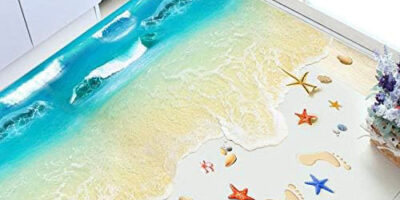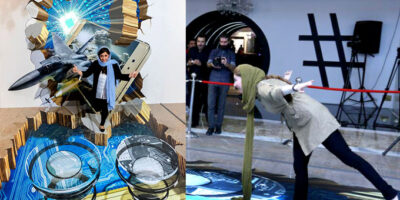

3D floor decals have drastically changed the way artists and designers engage with physical spaces. What was once impossible without a chalk artist, a marked viewpoint, and hours of drawing work can now be engineered, printed, and installed as a precision product to create the same mind-bending optical illusion on any suitable floor surface.
From retail stores and event venues to theme parks and illusion museums, 3D floor decals easily transform any space into an attention-grabbing experience. As these 3D floor graphics gain popularity for their visual impact and ease of application, more individuals and brands are turning to create immersive, interactive experiences that stop visitors in their tracks.
In this guide, we cover:
- How 3D floor decals create a convincing illusion
- The design and production process behind them
- Where 3D floor decals are used, and what makes them effective
- Real-world examples and answers to common questions
If you’d rather skip ahead and find an exciting design for your next project or campaign right now, explore our collection of 3D floor decals!
What Are 3D Floor Decals and How Do They Work
3D floor decals are printable, adhesive graphics applied to floor surfaces in order to create a convincing three-dimensional optical illusion when viewed from a specific angle.
Unlike a standard floor graphic, a 3D floor decal uses deliberate techniques for perspective distortion so the image appears flat or stretched from most positions, but resolves into a realistic scene that pops out if viewed from the intended viewing spot.

The Anamorphic Illusion Behind 3D Floor Decals
Designers draw on 3D anamorphic art techniques to create 3D floor decals in which the image is intentionally distorted yet appears to have real depth from a specific vantage point. If you’ve ever stopped in awe at a ground painting that seemed to crack open or drop into a hole, then you’ve experienced the power of anamorphic illusion used in 3D floor decals in action!
The history of this approach can be traced back to the Renaissance, when artists began experimenting with perspective and optical illusions. It was during this period that anamorphic techniques started gaining recognition, later popularized in large-scale public formats by contemporary artists like Kurt Wenner and Julian Beever.
In a 3D floor decal, the floor is treated as a flat plane in three-dimensional space. Designers define a specific viewing point based on the viewer’s position and eye level, and create the artwork from that perspective. The image is then precisely warped using projective geometry so that, from that exact spot, it appears natural, undistorted, and fully three-dimensional. As a result, the brain interprets the visual depth cues and perceives a realistic 3D scene that does not actually exist.
This is why the viewer’s position is not an additional detail to be taken lightly; it is a critical part of how the artwork functions.
3D Floor Decals vs. Chalk Art and Street Painting
3D floor decals are often associated with chalk pavement art and 3D street painting, and their underlying principle of illusion is the same. However, they are different products with different applications.
3D street paintings with chalk art are hand-drawn directly onto surfaces, such as pavements or floors, and are ephemeral by nature. 3D floor decals, by contrast, are digitally designed, professionally printed on engineered vinyl or film media, and installed as adhesive graphics.
They are durable, repeatable, and suitable for indoor commercial environments where chalk is not practical. The precision of digital design and print also allows for far greater detail, color accuracy, and consistency than hand-drawn work.
3D Floor Decals vs. 3D Floor Stickers
Now that you have the answer to “What are 3D floor decals?”, you might be wondering how they differ from 3D floor stickers!
The terms 3D floor decals and 3D floor stickers are often used interchangeably, and in most practical contexts, they refer to the same product. Both are printable, adhesive graphics applied to a floor surface to create a three-dimensional optical illusion. Creating 3D floor stickers and decals also follows the same process.
The distinction, however, lies in their scale and application. Floor stickers typically refer to smaller, self-contained graphic elements, such as a single image, a logo, or a compact illusion designed for a specific spot on the floor. Floor decals, on the other hand, describe larger-format or multi-panel installations that cover a significant floor area and are engineered as a complete system, including the base film, ink, overlaminate, and adhesive.
In fact, all 3D floor stickers are floor decals, but not all floor decals are stickers. For professional installations in retail spaces, events, or public environments, the full decal system, including its material specifications and slip-resistance considerations, is almost always required.
How to Create a 3D Floor Decal
Creating a 3D floor decal demands more than artistic talent and creativity. To make a floor decal 3D, the process involves a combination of creative design and precise technical execution. From selecting the right concept and defining the optimal viewing angle to applying anamorphic distortion and preparing the final print, each step plays a critical role in achieving a convincing illusion.
The following standard process ensures that the final outcome not only looks visually striking but also works seamlessly within its intended environment.
Step One: Designing the Illusion
Making a floor decal 3D starts with the artist or designer establishing the intended viewpoint; that is the specific position from which the illusion will be seen. Everything in the design flows from this decision.
Once the viewpoint is defined, the scene is built in 3D software or mapped geometrically. Then, the image is warped using anamorphic projection so that when it’s viewed from the correct angle, it snaps into a convincing three-dimensional scene.
The process typically involves:
- Sketching and conceptualizing the design based on the space and client’s vision
- Mapping out the perspective and proportions using a grid system to ensure accuracy
- Building or rendering the 3D scene from the designated viewpoint
- Applying the anamorphic warp to produce the final distorted artwork ready for print
- Adding shading, shadows, and highlights to reinforce depth and realism
After the projection mapping, you will have a printable file that looks stretched and skewed on screen but produces a striking 3D illusion once installed and viewed from the correct position.
Step Two: Choosing Materials, Print, and Finishing
A 3D floor decal is not simply a printed image; it is a layered material system, and the choice of materials directly affects its performance, durability, and safety.
Most professional floor decals are built on one of the following base films:
- Cast vinyl: high dimensional stability, low shrinkage, preferred for demanding environments and longer durations
- Calendered vinyl: thicker and easier to handle, well-suited for indoor flat surfaces and short-to-mid-term campaigns
- PET (polyester) films: PVC-free option with strong durability and published slip and fire ratings for indoor public environments
Over the printed film, an overlaminate is applied. On floors, this layer does three jobs at once: it protects the print from abrasion, resists cleaning agents, and, more critically, provides the slip resistance needed to make the decal safe to walk on.
Professional floor decals are tested to established slip resistance standards, such as R9 under DIN 51130, to ensure they meet safety requirements in commercial and public spaces.
Printing is typically done using UV-curable, eco-solvent, latex, or resin inks; each with different curing requirements and suitability depending on the environment and duration of use.
Step Three: Preparing the Surface and Installing 3D Floor Graphics
The magic of 3D floor stickers and decals becomes complete with proper installation. The surface must be thoroughly cleaned to remove grease, oil, wax, dust, and moisture before any adhesive film is applied. Most professional installers use a two-stage cleaning process, finishing with an isopropyl alcohol solution to ensure a clean, dry bond surface.
Key installation principles include:
- Applying the decal from the centre outward to avoid trapped air
- Avoiding placement of edges on grout lines or expansion joints
- Using rounded corners rather than sharp edges to reduce lifting risk
- Re-squeegeeing outer edges firmly for a proper edge seal
For large-format 3D floor graphics spanning multiple panels, seam and overlap management is critical; poorly finished seams are both a visual and a safety concern in high-traffic areas.
How to Remove Floor Decals
Removing 3D floor decals is straightforward, but it must be done carefully to avoid damaging the surface beneath. Most decals are made from adhesive vinyl, which can be removed with a combination of heat and gentle peeling. Before starting, it’s best to test a small corner to see how strongly the decal is bonded and whether any residue remains.
If you’re wondering how to remove floor decals, follow the steps below:
- Use a heat source (hairdryer or heat gun on low) to warm the decal and soften the adhesive
- Slowly peel the decal back at a low angle, starting from one corner
- If resistance increases, apply more heat and continue peeling gradually
- Remove any leftover adhesive using a suitable cleaner (e.g., adhesive remover or mild solvent)
- Wipe the surface clean with a damp cloth and let it dry
Taking your time during removal helps ensure a clean finish without damaging the floor.
How is the Experience of 3D Floor Decals
3D floor graphics are designed to be instantly engaging, turning ordinary spaces into interactive visual moments. As people approach, the illusion reveals itself, often surprising them. The experience of 3D floor decals boils down to the sense of depth, movement, or distortion that feels real from the right angle.
Immersion and Interactivity
One of the most compelling aspects of 3D floor decals is their ability to transport viewers into another world. When standing on or near a well-executed 3D floor decal, the combination of realistic visuals and the physical experience of being in the space creates a genuinely unique level of immersion. Whether it’s a serene underwater scene, an open sky beneath your feet, or a seemingly bottomless chasm, the viewer becomes part of the artwork.
This immersive quality has made 3D floor stickers and decals a popular choice across theme park design ideas, events, exhibitions, and public installations. Visitors don’t just stand around to admire the artwork, but they also step in, pose, and photograph themselves as part of the scene. The interplay between art and audience creates a dynamic, participatory experience that leaves a lasting impression.
Optical Illusions in Motion
One of the most captivating qualities of 3D floor decals is how they evolve as the viewer moves around them. From the intended viewpoint, the illusion is at its most convincing. As the viewer steps away or approaches from a different angle, the perspective shifts, revealing the distortion beneath the illusion and adding an element of discovery to the experience.
Artists and designers have explored this further by incorporating elements of implied movement into their compositions. Objects that appear to be falling, water that seems to be flowing, or creatures that look as though they’re in mid-motion are great instances. This dynamic quality keeps viewers engaged longer and makes the artwork a constantly evolving visual experience.
Where Do 3D Floor Decals Make an Impact
All 3D floor decals share one goal: to capture attention and create interaction.
In guerrilla marketing ideas, the 3D floor graphics are used to surprise and engage passersby, often turning into shareable social moments. In shopping malls, they help attract foot traffic and guide visitors, while in theme parks, they enhance the sense of excitement. In illusion museums, they go a step further, offering more than the visual impact by creating a learning opportunity to explore the principles of optical illusions.
Now, it’s time to dive deeper into the different use cases of these 3D floor graphics.
Interior Design and Retail Spaces
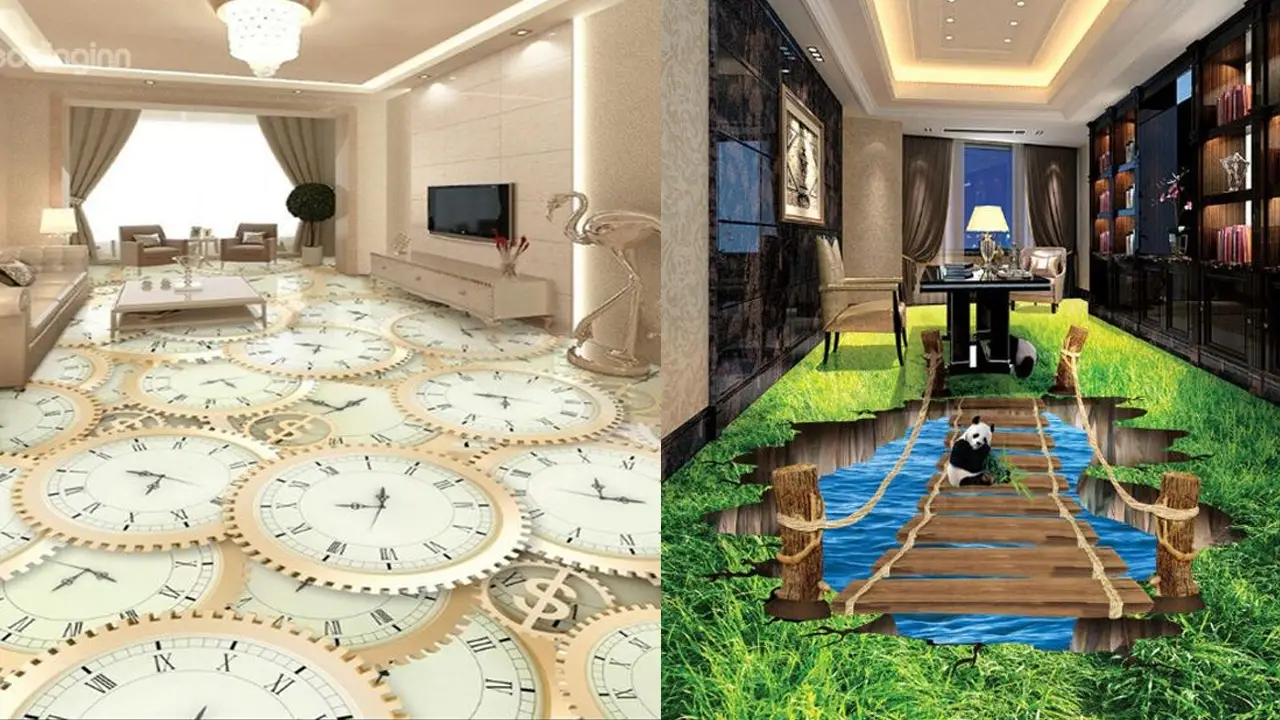
3D floor decals have become a go-to choice for interior designers and retail brands looking to create visually distinctive, memorable spaces. They can make a space feel larger by creating a convincing sense of depth, draw attention to specific areas within a store, or serve as a bold centerpiece in a lobby or showroom. The versatility of custom floor decals means the design can be tailored precisely to the dimensions, style, and brand identity of any space.
In retail specifically, the interactive nature of 3D floor graphics gives shoppers a reason to pause, engage, and share online, which translates into organic social media exposure.
Events, Exhibitions, and Brand Activations
Beyond permanent installations, 3D floor decals are widely used for temporary applications where high visual impact is needed quickly. Brand activations, product launches, trade show stands, and experiential marketing campaigns all benefit from the immediate attention a well-placed optical illusion floor decal generates.
They can be installed on event floors, inside exhibition spaces, or across public areas, then removed cleanly once the event concludes, provided a removable floor decal specification is used.
Theme parks and illusion museums represent some of the most ambitious applications of 3D floor decals, where they work alongside wall murals, anamorphic installations, and interactive exhibits to build fully immersive environments. In these settings, realistic 3D floor stickers are not decorative; they are a core part of the visitor experience.
What are Notable 3D Floor Decal Installations
Over the years, 3D floor art has gained international recognition, with installations appearing in public spaces, commercial venues, and dedicated illusion experiences around the world.
One of the most famous 3D artists is Kurt Wenner, who is widely credited with developing the geometric system that makes convincing 3D pavement illusions possible. His large-scale works demonstrated the potential of anamorphic perspective at a public scale, a principle that directly underpins modern printed 3D floor decals.
A more recent example of 3D floor decals in a commercial context is their use in retail and brand environments. Studios produce highly detailed optical-illusion floor graphics, such as underwater scenes, cracked earth, and infinite-depth effects, printed on professional vinyl systems and installed in shopping centres, airports, and museums worldwide. These installations demonstrate how the same anamorphic illusion principle, when applied to a printed and engineered product, can be deployed reliably and repeatably at scale.
The common thread across all notable examples is the same: a precisely calculated viewpoint, a distorted image designed around it, and an audience that arrives at the right spot and sees something that genuinely surprises them.
Where to Get 3D Floor Decals
When it comes to 3D floor decals, the quality of design and precision of execution make all the difference. Off-the-shelf solutions may offer quick visuals, but truly impactful results require custom-designed illusions tailored to your space, audience, and viewing angles. That’s where working with an experienced design studio comes into play.
SALSO Design Studio specializes in creating high-quality, custom 3D floor graphics using advanced anamorphic design techniques. From concept development to final production, the team ensures that each project is visually compelling, technically precise, and aligned with its intended environment.
If you’re looking to create a standout visual experience, partnering with our team of 3D artists ensures your 3D floor decal delivers maximum impact and engagement. Explore our 3D design portfolio to learn more about what we do and how we can help bring your idea to life!
Conclusion
In this blog, we’ve explored the meaning of 3D floor decals, how they are created, and where they are used. More than just decorative elements, these 3D floor graphics are visual tools with immense power to turn any ordinary space into engaging, interactive experiences.
At Salso Design, we design and produce 3D optical illusion installations for brands, venues, theme parks, and museums. Make sure to reach out today and get started on your next 3D floor decal!
Frequently Asked Questions
Below, we’ll answer some of the most common questions about 3D floor decals.
A 3D floor graphic is a broad term, referring to any visual design applied to a floor surface that creates the illusion of depth, dimension, or a three-dimensional scene. 3D floor graphics typically use perspective-based (anamorphic) design techniques, and can be produced in different ways, including printed vinyl, painted murals, or even integrated materials within flooring.
A 3D floor decal is a specific type of 3D floor graphic. It refers to a printed design on adhesive vinyl that is applied directly onto the floor. Decals are usually:
– Easier to install and remove
– More cost-effective
– Ideal for temporary or semi-permanent use (e.g., events, retail campaigns)
Yes, but only if they are professionally produced and installed. Quality floor decals include an anti-slip overlaminate that meets established slip-resistance standards, such as R9 under DIN 51130, making them safe for foot traffic in commercial and public spaces. Slip resistance ratings should always be confirmed before installation in high-traffic environments.
Durability depends on the materials used, the level of foot traffic, and the environment. Indoor floor decals on sealed flat surfaces typically last from several months to over a year under normal conditions. Outdoor or high-traffic installations may have shorter life expectancy and require more robust material specifications.
Yes; custom floor decals can be designed to any dimension, subject, or brand requirement. The anamorphic design is calculated specifically for the installation space and the intended viewing position, meaning every project is tailored to its environment. Removable floor decal options are also available for temporary campaigns or events.