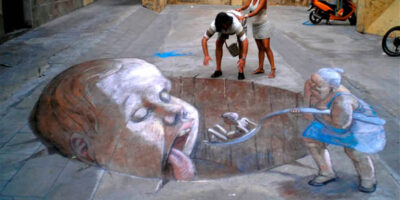

What is 3D painting? It is an art technique that creates the illusion of depth and volume on a flat surface, making an image appear real from a specific viewing angle. What looks like a hole in the ground, a rising object, or a moving scene is actually a carefully distorted, 3D painting design that tricks the eye.
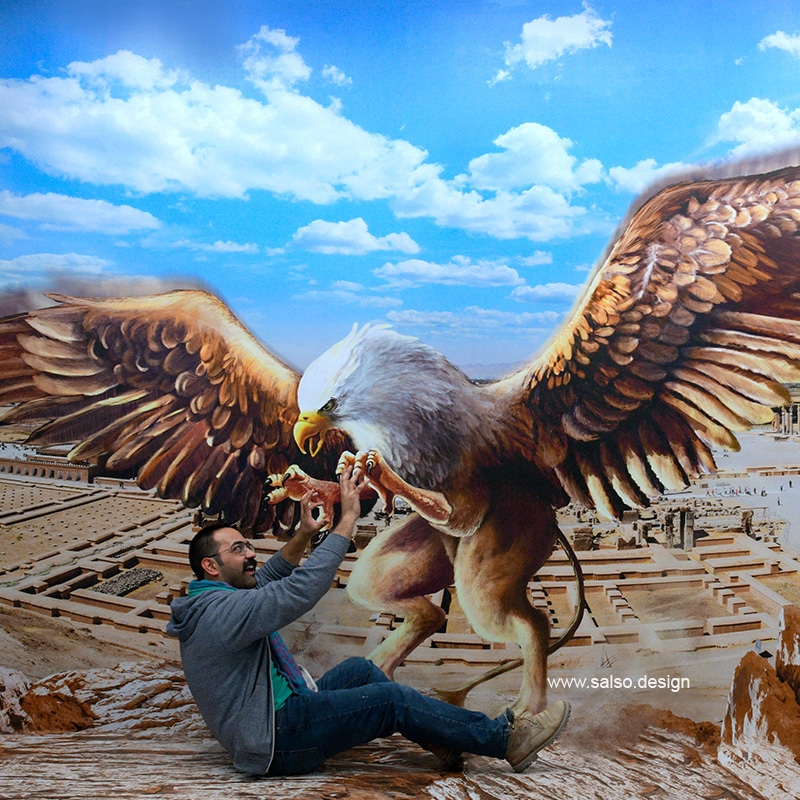
Many 3D paintings you see on streets, walls, or online use anamorphic illusions to trick your perception. That’s why these 3D paintings are often known as anamorphic paintings. While the anamorphic painting may look stretched or unclear at first glance, it makes complete sense from the right angle. Once viewers catch that right angle, they can pose and take pictures next to the 3D artwork as the scene feels alive and interactive. Understanding the answer to “what is a 3D painting?” helps you see why this art form feels so immersive and memorable. So, keep reading to explore:-
- How 3D paintings work,
-
- Where they are used,
-
- And the different types of 3D painting.
What Is 3D Painting
3D painting is a visual art form that relies on perspective, scale, and optical illusion to guide the viewer’s perception of an image. To ensure the artwork appears three-dimensional from a chosen viewpoint, 3D artists control:
-
- Lines,
-
- Proportions,
-
- And angles.
This is why placement and viewing position matter as much as the design itself. In practice, these 3D painting designs can be used on both flat surfaces (walls and floors) as well as those with curves or angles. 3D street paintings are amusing instances of how the angle makes all the difference.
As 3D paintings evolve, different approaches and types of 3D painting continue to emerge across art, design, and visual storytelling. Digital methods have expanded 3D artwork, allowing artists to plan complex illusions before execution.
Apart from learning the answer to “what is 3D painting?” we should also find out the different use cases and applications in the modern world!
Applications of 3D Painting
At first glance, a 3D painting is a funny and interesting technique for photography and entertainment. While entertainment is a major goal, its practical uses go much further.
Common applications of 3D art painting include:
-
- Decoration design that adds realistic depth instantly
-
- Building facade design that draws public attention quickly
-
- Interior design that creates immersive spaces creatively
-
- Guerilla marketing ideas that boost engagement
-
- Magazine design that captures the reader’s interest visually
-
- Graphic design projects that deliver lasting impact
Different Types of 3D Painting
To understand “what is 3D painting”, we need to explore the different types. Artists create 3D paintings using different approaches that affect their final appearance and potential uses. The two main types of 3D painting are defined by how the design starts and finishes.
One relies fully on hand skills while the other uses digital tools for precision and easy reproduction. Both methods produce striking illusions, but each suits specific projects and creative goals.
1- Manual 3D Painting (Analog)
Manual 3D painting is created entirely by hand on the chosen surface. The artist sketches the distorted image directly with chalk, paint, or markers. No computer software guides the process.
This method demands strong drawing skills, exact measurements, and constant checks from the intended viewing spot. 3D street artists often choose this approach for live events and public spaces because it feels authentic and connects with audiences in real time.
The work stays unique since every piece is one-of-a-kind. Weather, surface texture, and time limits can challenge the artist, but the result carries a personal touch that many viewers appreciate.
Famous street painter Julian Beever uses manual techniques to create giant pavement illusions that draw crowds for photos and videos. His 3D floor decals show how hand-drawn precision turns flat ground into believable scenes like swimming pools or giant books.
2- Digital 3D Painting
Digital 3D painting begins on a computer with software that helps plan the distortion and perspective. Artists model the scene, adjust angles, and test viewpoints virtually before any paint or print touches the surface.
After approval, the design can create 3D floor stickers, posters, or wall wraps, or project as a guide for hand-finishing. This method offers fast changes, perfect scaling, and easy repeats for commercial jobs.
Printing expands options to 3D wall paintings or those on large facades and even curved surfaces. The process suits advertising campaigns and interior projects that need quick delivery and consistent quality.
Iranian artist Saleh Sokhandan often works digitally. He combines computer-rendered illusions with physical elements, like the boat volume in his “Venice” piece. The printed 3D sticker blends seamlessly with the added structure, enhancing depth and making the artwork more immersive.
How Do Artists Create a 3D Painting
Now that we’ve explored the answer to “what is 3D painting?” it’s time to delve deeper into the creation process. 3D anamorphic illustrations and paintings are created on a flat 2D surface using distorted perspective techniques. Artists apply anamorphosis to stretch and warp the image so it appears correct only from a specific viewpoint.
The optical effect relies on careful planning of perspective and viewpoint. So, from most angles, the artwork looks stretched, abstract, or even confusing; however, when viewed from the precise spot, it transforms into a striking 3D painting that seems to pop out in realistic detail.
Dutch artist Leon Keer is among the most famous 3D artists and a leading figure in modern anamorphic street art. He often paints large-scale murals and adds augmented reality elements for extra depth. His works stand as the best instances of 3D paintings and their impact.
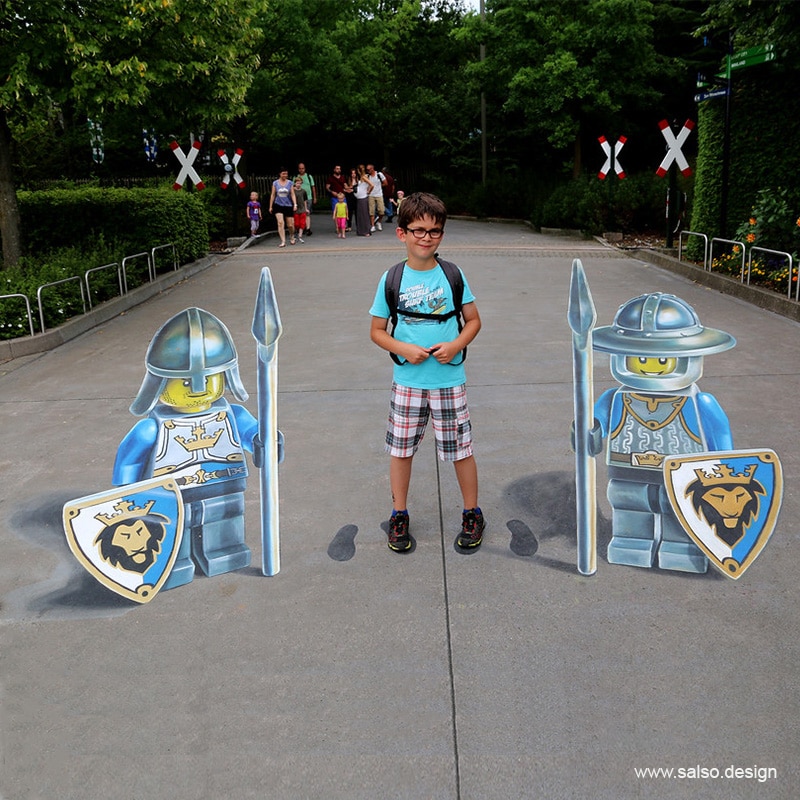

Why Use 3D Painting: Benefits of 3D Artwork
Artists, brands, and designers choose 3D painting for many reasons beyond its visual appeal. Here are the key benefits of 3D artwork:
-
- Grabs attention instantly: The illusion of depth stops people and makes artwork stand out in any crowded space.
-
- Creates interactive experiences: Viewers love posing with these pieces, which turns them into active photo shoot spots.
-
- Boosts brand visibility: Businesses use illusions to draw crowds and generate social media buzz.
-
- Transforms ordinary spaces: A blank wall becomes a destination without costly construction.
-
- Shows artistic skill: Mastering perspective and shadow demonstrates advanced technical ability.
-
- Offers versatile applications: Different types of 3D painting suit festivals, exhibits, ads, and interior design projects.
Various applications of anamorphic painting
3D painting at first glance is a funny and interesting work for photography and fun. This is a very good goal because creating enjoyable moments for the audience is one of the artist’s goals. But 3D painting has other applications in various fields.
Decoration design, building facade design, interior design, advertising, magazine and newspaper design, graphic design, and other subjects are different applications of a 3D painting.


How Do Artists Push the Boundaries of 3D Painting
The impact of other visual acuity techniques on 3D painting is significant. A variety of effects can be created by combining optical illusion techniques. Many 3D artists are constantly innovating by blending 3D painting with other art forms.
Graffiti and 3D Art
Some artists, like the Portuguese artist Odeith, have focused their careers on graffiti work, creating a new atmosphere in 3D painting. His style, often called “Sombra,” makes it look as though objects are casting realistic shadows on the wall.
Mixed Media and 3D Painting
Others combine the flat 2D illusion with actual physical objects. For example, Saleh Sokhandan, an Iranian artist, combines digitally transformed paintings with volumes. This creates a powerful mixed-media experience.
The 3D painting below is called “Venice,” an artwork by Saleh Sokhandan. You can see the 3D effect combined with the volumes. This work has been designed and performed with a digital 3D painting technique and printed as a 3D sticker. In his art piece, Sokhandan has built a volume in the shape of a boat, which is combined with 3D painting techniques to make the piece more attractive.

Last Words on What Is 3D Painting
Exploring “What is 3D painting?” we came to one simple answer: 3D paintings are artworks that transform flat surfaces into immersive visual experiences through perspective and optical illusion. The technique has wide use cases, from 3D street art chalk masterpieces to digital mixed-media works. Regardless of where the 3D artwork is placed, it quickly becomes an attention-grabber.
3D painting artists like Leon Keer and Odeith push creative boundaries, while innovators like Saleh Sokhandan blend digital precision with physical elements for stunning results.
To find stickers and posters of 3D paintings, check our shop now!
FAQs on What Is a 3D Painting
We get various questions about 3D artwork, from “what is 3D painting” to “what is 3D wall painting” and more. Here are the frequently asked questions about 3D illusion paintings, along with their answers.
1- What Is the Difference Between 3D and 5D Diamond Painting?
A common question is, “What is the difference between 3D and 5D diamond painting?” It’s important to clarify that diamond painting (including kits labelled 3D or 5D) is a completely separate craft from 3D painting.
The “3D” or “5D” in that context refers to the facet cut of the diamonds, not an optical illusion. So, if you’re asking yourself, “What is 3D diamond painting?” it is simply a diamond painting kit that uses diamonds with 3 facets for extra sparkle. It has no relation to the anamorphic art form we have discussed here.
2- What Is 3D Wall Painting?
It is a 3D painting applied to a vertical surface like an interior wall, building facade, or mural space. Artists use the same anamorphic distortion techniques to make the artwork appear to pop out from the wall. These installations transform flat surfaces into immersive, eye-catching visual experiences.
3- What Is 3D Diamond Painting?
3D diamond paintings are a craft where artists place small resin diamonds onto a sticky canvas to create a shimmering mosaic. Each drill has three faceted sides that catch light. The finished piece has a textured, jewel-like surface. This differs completely from illusion-based 3D painting, which relies on perspective tricks.
4- What Is 3D Painting Called?
The accurate artistic term for 3D painting is anamorphic painting or anamorphosis. This describes the distorted projection technique, where images only resolve correctly from one viewpoint. Street artists also call it pavement art or 3D street painting.
5- What Is Used for 3D Painting?
Artists use various materials depending on the surface and setting. Sidewalk chalk works for temporary street art. Acrylic paints suit permanent murals and 3D wall painting projects. Digital artists use software to plan illusions before printing. Some creators also combine physical objects with painted elements for mixed-media depth effects.