Theme park design ideas only succeed when they are engineered as a complete system. It should be a connected system where the story, layout, capacity, guest flow, queues, accessibility, safety standards, and delivery all work together. When you design the system correctly, you reduce bottlenecks, improve guest satisfaction, make the project easier to build and operate, and expand.
This blog is your guide to theme park design ideas and implementation! Here, we’ll explain:
- How to design a theme park from scratch (from feasibility to opening) with operations and guest flow built into the design from the start.
- How to prepare a credible concept for investors, stakeholders, or a university brief—with clear stage deliverables, practical assumptions, and buildable outputs.
- Discover theme park design ideas and concepts that scale with attendance—so the experience stays enjoyable at peak days, not just in renders.
- Read case studies of themed environments, illusion-based attractions, and high-impact visual moments.
If you want a faster path from your “cool” theme park design ideas to a concept that stands up to feasibility, master planning, and investor conversations, contact SALSO Design Studio today. Our team helps developers and brands structure theme park and attraction projects with buildable logic—so the story, circulation, queue strategy, and capacity math are aligned from day one. So, if you need design assets you can adapt into themed walkthroughs, photo moments, branded installations, and visual backdrops, make sure to check SALSO shop or reach out.
How to Design Theme Park Ideas from Feasibility to Opening
For designing a theme park, start by sizing the park to real demand, then move from concept to master plan to delivery. If you treat operations, queues, and safety as “later problems,” they will become expensive redesigns. Instead, make them design inputs from day one.
Your planning approach should:
- Treat guest flow and operations as design constraints, not post-opening fixes.
- Build safety requirements into the design before you draw detailed attractions.
- Use clear stage deliverables so decisions are made once and made well.
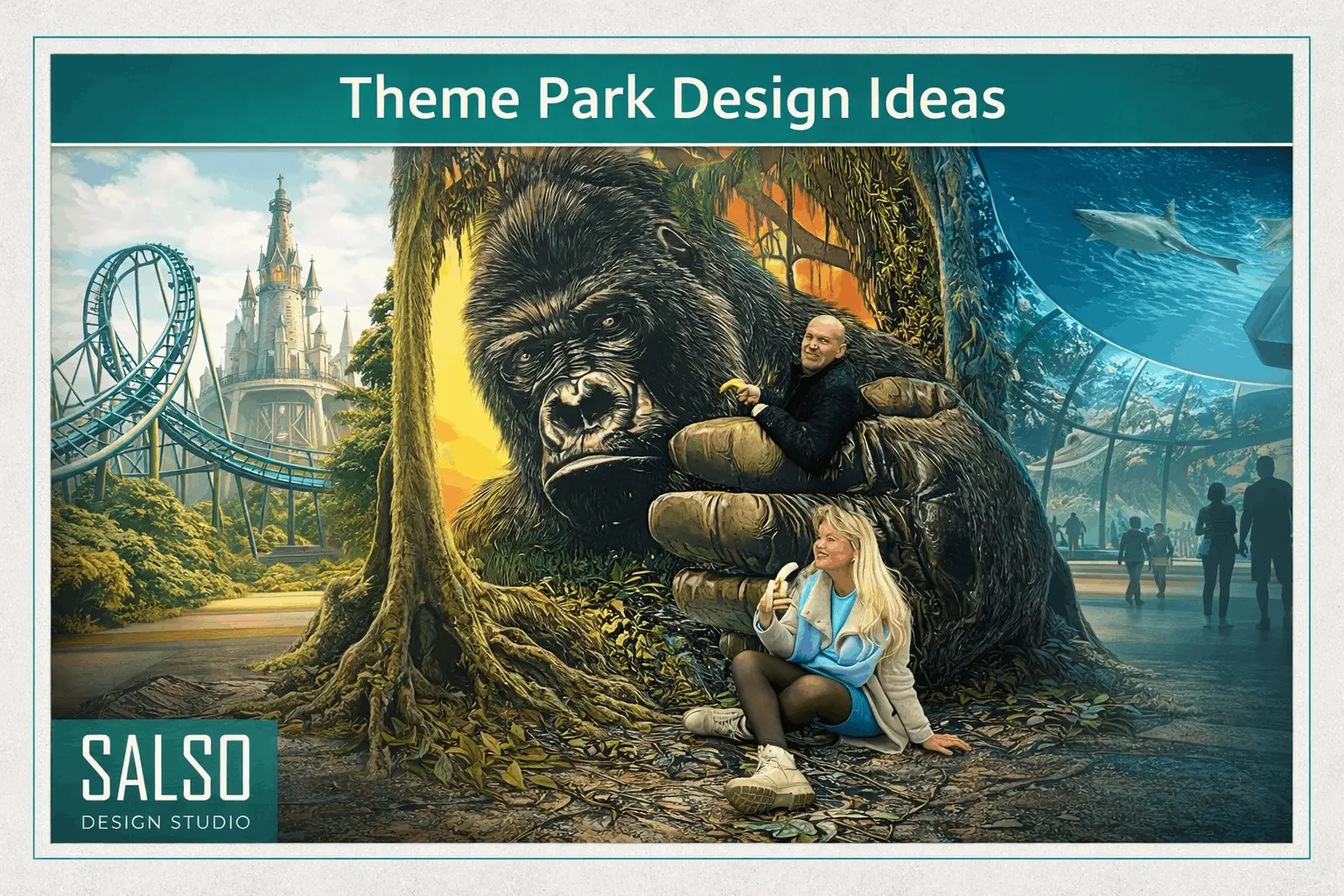
For instance, to create a kid-friendly photo moment where children can “pose with” a giant King Kong Mural, one of our clients started with a SALSO-made 3D mural concept.
Step 1: Feasibility + “Design Day”
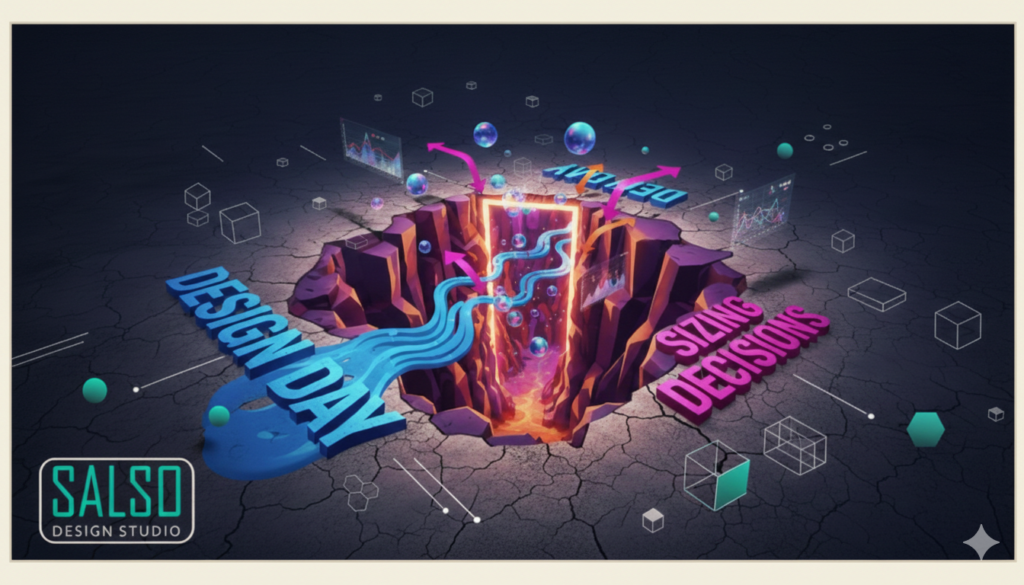
A feasibility study estimates demand and helps you choose a park size that matches the market. Your key benchmark is Design Day: the peak-day planning number you use to size walkways, amenities, and hourly ride/show capacity.
To do so, follow these steps:
- Define your catchment area, tourism drivers, seasonality, and pricing sensitivity.
- Estimate peak-day attendance and peak in-park occupancy.
- Convert that number into sizing targets for circulation, restrooms, F&B, parking, and attraction capacity.
Mini-example: If your Design Day is 20,000 guests, set targets for (1) peak in-park occupancy and (2) total hourly attraction/show capacity so the park does not “stall” at peak. Your walkway widths, restroom counts, and show schedules should all trace back to that single benchmark.
Step 2: Creative concept (central idea → themed lands)
Developing a theme park project becomes coherent when one central idea drives the park’s identity and guides every land, attraction, and visual cue.
To go from theme park design idea to developing your project, follow these steps:
- Write a one-page concept brief (world, tone, audience, promise).
- Translate it into 3–6 themed lands with distinct landmarks.
- Define the hero moment at entry and the memory moment near exit.
Mini-example: If your concept is “Myth & Monsters Harbor,” your entry hero moment might be a lighthouse fortress reveal, while the exit memory moment could be a nighttime “harbor awakening” show that encourages repeat visitation.
Step 3: Master plan (choose layout logic + legible circulation)
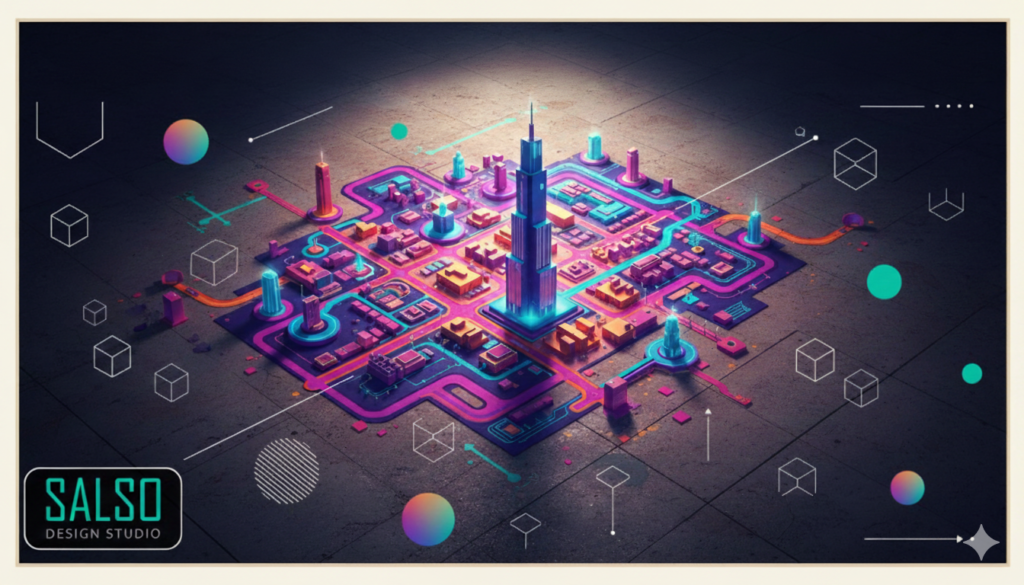
Your theme park master plan design should be readable at a glance. When guests understand where they are and where they can go next, you reduce confusion and stress.
To develop a master plan:
- Choose a layout logic: hub-and-spoke, loop, or hybrid.
- Place a landmark in each zone to make wayfinding intuitive.
- Avoid dead ends unless they deliver a strong “show moment” and a clear return path.
Mini-example: A loop plan works well for first-time visitors because it naturally brings guests back toward the entry without requiring them to retrace long distances.
Step 4: Attraction program (balance ride types + throughput by zone)
Capacity influences guest satisfaction as much as story. If one land collapses under demand, immersion breaks—because queues and congestion dominate the experience.
For your attraction program:
- Build a balanced mix: headliners, family anchors, kids’ capacity, and shows.
- Plan hourly throughput per zone to distribute demand.
- Add “people-eaters” (shows, walkthroughs, interactive exhibits) to stabilize peak days.
Mini-example: If one headliner draws disproportionate demand, counterbalance it with a nearby high-capacity show that runs every 20–30 minutes to absorb crowds during peak hours.
Step 5: Queue design (improve perceived waits)
Queues are not a side-effect; they are a design tool. You can reduce perceived waiting by keeping guests engaged, comfortable, and aware of progress. Evidence from open-access research shows active occupation improves flow and wait satisfaction and can increase intentions to return.
Do this:
- Add active queue moments: puzzles, mini-missions, tactile elements.
- Show progress: visible milestones, partial reveals, and “near payoff” cues.
- Engineer comfort: shade, ventilation, water access, and clear information.
Mini-example: If your average queue is 45 minutes, design 3–5 “beats” (interactive stations or story reveals) so guests feel movement and meaning rather than delay.
Step 6: Safety + compliance (ASTM/EN/ISO + local authorities)
Safety is not something you “add later.” Standards shape ride design, testing, operations, maintenance, and inspection planning. In themed entertainment, common frameworks include:
- ASTM F24 standards (widely used in the amusement industry, especially in the U.S.)
- IAAPA overview of ASTM safety standards (industry-facing guidance and context).
- ASTM F2291 (a core design practice for amusement rides and major modifications).
- EN 13814 (European standard series covering design/manufacture and operation/maintenance requirements).
- Plus local authority requirements (permits, inspection regime, fire/life safety, accessibility).
Do this:
- Build a standards matrix early (ASTM/EN/ISO + local codes).
- Document safety-critical assumptions and decisions as you design.
- Design inspection and maintenance access into architecture and theming from the start.
Mini-example: If a ride’s access platform is required for inspection, you can hide it inside theming only if you preserve clearances and safe working access; otherwise, you create costly rework.
Step 7: Delivery coordination (architecture + MEP + show systems)
Late-stage surprises happen when disciplines design in isolation. Reduce risk by coordinating architecture, structure, MEP (Mechanical, Electrical, Plumbing), ride interfaces, and show systems from early design through fabrication.
If you use BIM (Building Information Modeling), treat it as a coordination process—not just a 3D model—so teams control versions, detect clashes early, and lock decisions before procurement.
Do this:
- Link architectural/structural/MEP/show models with strict version control.
- Run clash detection at defined milestones before fabrication/procurement.
- Model operational requirements (staff routes, storage, maintenance) so the built park can actually run efficiently.
Mini-example: Before you finalize scenic ceilings, run a coordination check for sprinkler/duct/lighting conflicts—because a single late conflict can force a chain of rework across multiple disciplines.
You may be interested in our related article: Where to buy 3d floor stickers
Theme Park Design Ideas Checklist (Research-Backed Rules You Can Apply)
The fastest way to improve theme park project design is to turn “ideas” into a checklist tied to evidence: legibility, queue psychology, capacity math, and standards-led safety.
| Checklist item | What “good” looks like | Evidence |
| Wayfinding and legibility | Landmarks per zone; clear districts; consistent sightlines/signage | Wayfinding difficulties associate with negative consequences; landmarks are vital for wayfinding. |
| Queue experience | Active occupation beats + comfort + progress visibility | Active (vs passive) occupied waiting improves flow and wait satisfaction. |
| Safety and standards | Standards matrix + documentation + inspection-ready design | IAAPA overview of ASTM; ASTM F24 committee scope; F2291 design criteria; EN 13814 series. |
| Coordinated delivery | Interdisciplinary BIM coordination + clash detection milestones | Delivery coordination is a known risk reducer in complex multidisciplinary builds (BIM coordination best practice). |
Theme Park Project Ideas: 12 Concepts You Can Build a Full Design Around
When you pick theme park project concepts, choose one that naturally produces: (1) themed lands, (2) landmark icons, (3) queue stories, and (4) a repeatable circulation loop. The 12 concepts below are structured so you can take one idea and expand it into a full project—from concept through master plan and attraction mix.
1) Myth & Monsters Harbor (hero landmark: lighthouse fortress)
This concept makes guest flow intuitive: the lighthouse becomes the navigation anchor, and the harbor loop naturally reduces dead ends.
- Build a loop path with “dock districts” as mini-lands.
- Use active queue missions: “collect relic stamps” while waiting.
- Place food/retail at sightline “nodes” so spending follows movement.
2) Desert Mirage Expedition (hero landmark: shifting “mirage” tower)
This is ideal if you want to integrate perception-based scenic tricks and interactive illusions as attractions.
- Use heat/shade logic: shade arcades to improve comfort and queue stability.
- Add “mirage moments” as active waiting features (puzzles, optical illusions).
- Zone the thrill ride deeper to pull guests through the land.
3) Neo-Future Transit City (hero landmark: central station hub)
A hub-and-spoke station layout is readable and supports rapid dispersal on peak days.
- Make the station your main node and show-control “heartbeat.”
- Put family capacity on spokes, thrill anchor on a loop.
- Use digital queue reservations and progress displays (where applicable).
4) Jungle Bio-Dome Discovery (hero landmark: giant conservatory dome)
A dome creates a single icon and helps weather-proof the experience (useful in extreme climates).
- Run a continuous indoor loop with controlled “chapter” transitions.
- Use interactive ecology stations as active waiting.
- Places show at midpoints to absorb peak demand.
5) Underwater City Walkthrough (hero landmark: “glass” tunnel boulevard)
This concept is strong for walk-through capacity and photo-driven repeatability.
- Prioritize legibility with a single main boulevard and themed side streets.
- Use sound/light transitions to signal districts.
- Add interactive “scan-and-unlock” exhibits in queues.
6) Steampunk Skyworks (hero landmark: rotating gear tower)
Steampunk is excellent for kinetic placemaking and “mechanical storytelling.”
- Build a loop around the gear tower to support navigation.
- Put a family coaster as the visible “moving skyline” attraction.
- Add queue activity: “calibrate the machine” interactive panels.
7) Festival of Worlds (hero landmark: central parade plaza)
This concept is designed for seasonal overlays and special events, which industry reporting frequently frames as a lever to attract guests and drive repeat visitation.
- Create modular vendor streets that can be reskinned by season.
- Schedule stage shows to manage crowd distribution.
- Use “passport stamp” interactions to occupy waits.
8) Ancient Ruins Time-Portal (hero landmark: portal gate)
This is a clean narrative device: each “time era” becomes a land.
- Use distinct materials/colors per era to reinforce district legibility.
- Place a high-capacity dark ride as the anchor “portal jump.”
- Add queue puzzles: “solve the runes” active occupation.
9) Polar Lights Adventure (hero landmark: aurora dome)
This supports nighttime spectacle and lighting-driven placemaking.
- Design a nighttime show spine to concentrate evening crowds.
- Use indoor queue zones for comfort and flow stability.
- Layer soundscapes and lighting to guide movement.
10) Extreme Sports Canyon (hero landmark: cliff jump tower)
This is straightforward for a “thrill identity” park.
- Put thrill icons on the skyline to pull guests deeper.
- Add spectator terraces as capacity buffers.
- Use clear safety separation and standards-led barriers.
11) Storybook Mini-Kingdom (hero landmark: castle library)
A family-first park benefits most from high legibility and gentle continuous loops.
- Use a simple loop with short distances and abundant seating.
- Add interactive queue story pages (active occupation).
- Put restrooms/food at nodes to minimize “search time.”
12) Illusion & Light Lab Park (hero landmark: immersive light hall)
This concept aligns with Salso. design’s strengths: perception, optical illusions, and immersive installations.
- Design “photo moment stations” as distributed nodes to reduce congestion.
- Use interactive illusions inside queues to improve wait satisfaction.
- Plan fabrication early so scenic intent matches build reality.
Case Studies: What major themed reinvestment can change
Attendance gains are often linked to large, marketable reinvestments—especially when a new land provides a clear “reason to visit.” Industry reporting and Theme Index commentary frequently frame reinvestment and strong IP activation as demand drivers, but the park must scale capacity and operations to protect experience quality. AECOM Theme Index hub (reports archive/downloads)
Case study 1: Disney California Adventure — Cars Land
Industry coverage of TEA/AECOM Theme Index results reported a major year-over-year increase following Cars Land, commonly cited at +22.6% in 2012, with attendance around 7.8 million. Cars Land attendance coverage referencing Theme Index results
What this implies for design:
- A land-scale addition can be easier to market than a single ride.
- A single iconic headliner inside a coherent land can concentrate demand.
- Capacity, circulation, and amenities must scale with the marketing success.
Case study 2: Universal’s Islands of Adventure — Wizarding World of Harry Potter
Reports referencing TEA/AECOM analysis described a large jump—about +1.725 million visitors (+29%)—associated with the Wizarding World’s impact in its first full year period. Wizarding World / Islands of Adventure +29% summary referencing TEA/AECOM analysis
What this implies for design:
- IP can be a powerful growth lever—but it increases peak-day pressure.
- Land identity simplifies marketing, but operations must protect guest experience.
- Plan crowd routing, show scheduling, and queue strategy as “demand management.”
Case study 3: Queue experience design — active vs passive occupation
A 2025 open-access study found that active waiting increases flow, which improves wait satisfaction and can increase intentions to return (compared to passive or non-occupied waiting). 2025 open-access paper on active vs passive occupied waiting (Journal of Business Research)
What this implies for design:
- Interactive queue design is not decoration; it is an experience lever.
- Combine story beats, comfort, and progress visibility for the best effect.
- Long waits still hurt—so pair queue design with real capacity planning.
Final Thoughts
Great theme parks are engineered, not improvised.
The strongest parks succeed because they integrate storytelling, circulation, queues, accessibility, safety, and operations into a single coherent system. Whether you are researching theme park design ideas, learning how to design a theme park, or developing theme park project ideas, the framework above is built to hold up in real-world delivery.
Why SALSO Design Studio Is Trusted for Theme Park Design Projects
Designing a high-performing theme park requires full-system integration, from storytelling and master planning to safety engineering and operational design.
SALSO Design Studio (salso.design) specializes in theme park planning, scenario development, and destination-scale design for developers, investors, and public-sector clients.
Our expertise includes:
- Theme park master planning and circulation design
- Storyworld and scenario development
- Feasibility and capacity planning
- Queue, accessibility, and guest-flow engineering
- Safety-first attraction integration
SALSO approaches every theme park as a long-term destination, not a collection of rides. Our planning methodology ensures commercial viability, operational efficiency, and guest satisfaction from day one.If you are planning to design a theme park, develop a new entertainment destination, or create a mixed-use attraction, SALSO can provide the technical and creative foundation to move from concept to a buildable master plan.
Frequently Asked Questions About Theme Park Design
Designing a successful theme park requires more than creative concepts. It demands structured planning, engineering expertise, and proven experience. Below are answers to the most common questions about theme park design ideas, project development, and professional park planning.
What are the best theme park design ideas?
The best theme park design ideas focus on the complete guest experience—storytelling, circulation, queue design, accessibility, safety engineering, and operations working as one system.
How do you design a theme park?
Professionals follow a structured process: define the project, run feasibility and programming, create a master plan, develop schematic-to-detailed design, then implement, test, train, and optimize through opening.
What is included in a theme park project design?
A theme park project design typically includes: master planning, attraction and commercial mix, circulation and capacity modeling, queue design, accessibility strategy, safety standards pathway, and expansion planning.
Who should design a theme park?
A theme park should be designed by a specialized themed-entertainment studio capable of integrating master planning, storytelling, ride interfaces, code/safety frameworks, and operational design into one coordinated delivery model.